Author: admin

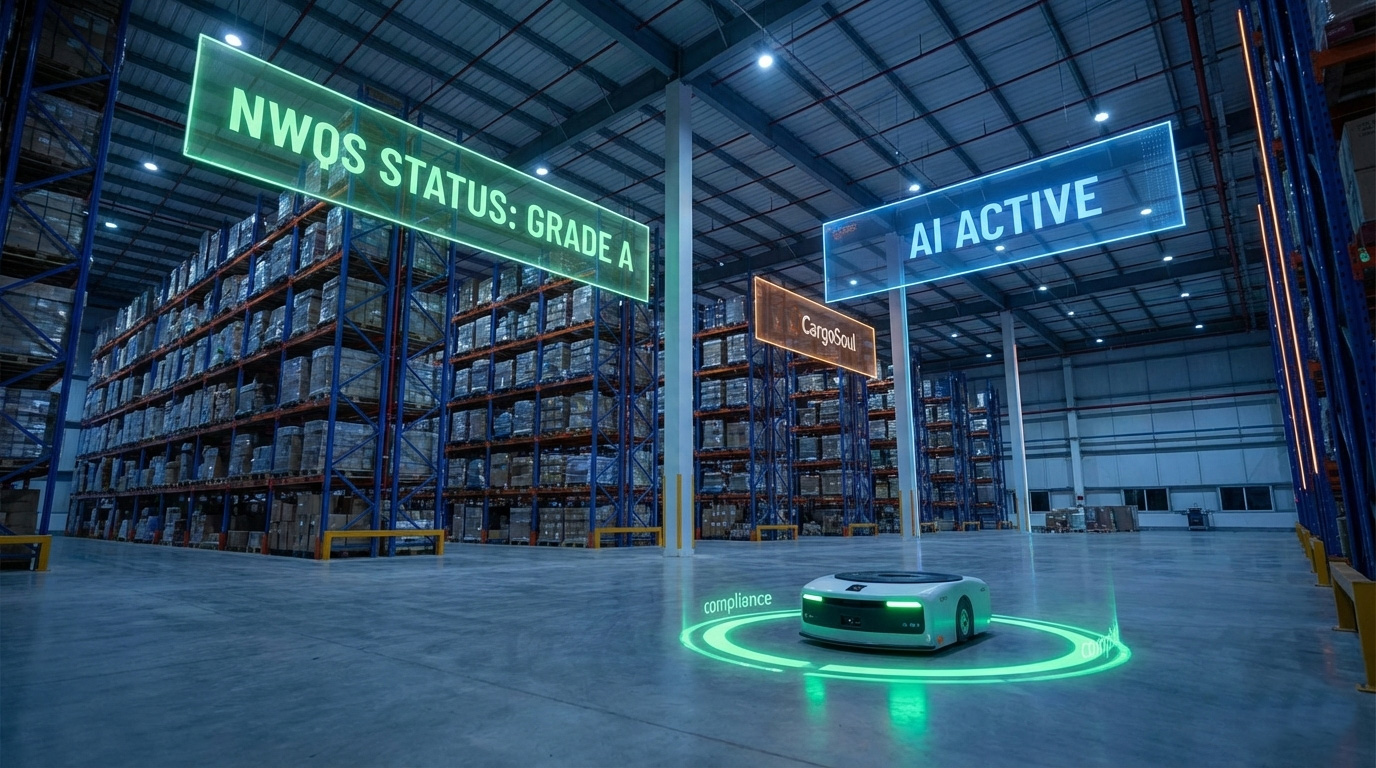
  • The Ultimate NWQS 2026 Compliance Checklist for Indian Warehouse Operators

    The Ultimate NWQS 2026 Compliance Checklist for Indian Warehouse Operators

    The 120-Day Countdown: Is Your Warehouse NWQS Ready?

    The year 2026 has arrived, and with it, the “Compliance Cliff.” The Warehousing Development and Regulatory Authority (WDRA) has clarified that standardized quality is no longer optional for those seeking to be part of India’s global supply chain.

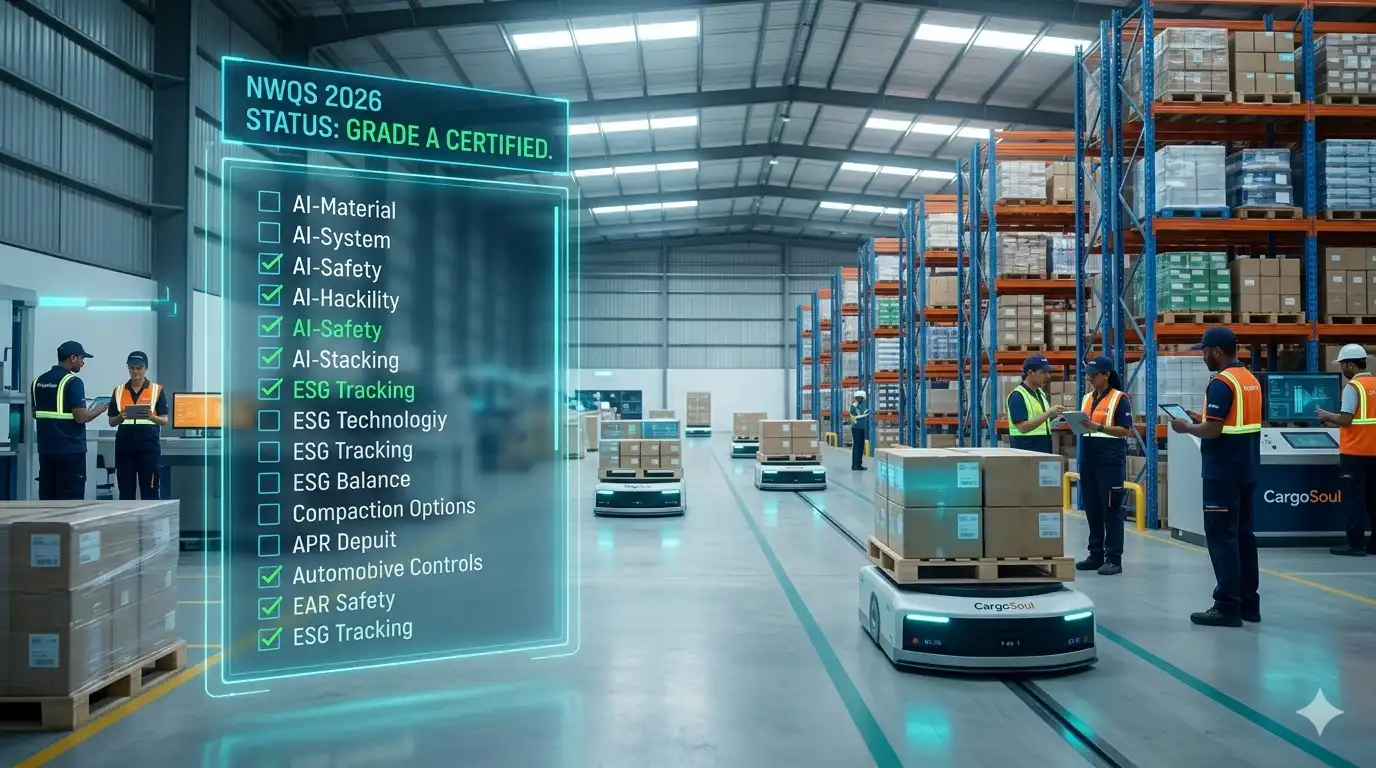
    Whether you are an MSME operator or a large-scale developer, use this 15-point audit to ensure your facility doesn’t just survive but leads.

    I. Infrastructure & Perimeter Standards

    • [ ] WDRA Effective Control: Can you prove exclusive and effective control over the premises? (Multiple registrations on one lease are now strictly prohibited).
    • [ ] Plinth & Structural Height: Does your plinth height meet the minimum 70cm requirement to prevent flooding?
    • [ ] Perimeter Security: Is there a clear, gated boundary wall or barbed wire fencing? (Open-space warehouses are now flagged as high-risk).
    • [ ] 3-Meter Buffer: Ensure no trees or combustible structures are within 3 meters of the godown platform.

    II. Safety & Fire Suppression (2026 Updates)

    • [ ] Digital Fire Logs: Are your fire safety inspections recorded in a tamper-proof digital log? (Manual clipboards are no longer compliant).
    • [ ] AI-Based Smoke Detection: Does your system include AI-enabled thermal/smoke detection that triggers automated alerts to facility managers?
    • [ ] Advanced Suppression: Are hydrants, hose reels, and extinguishers positioned per the updated National Building Code 2026?
    • [ ] Lithium-Ion Safety: If you handle electronics, do you have specialized Class L fire suppression for lithium battery risks?

    III. Operational & Digital Integrity

    • [ ] ALCOA+ Data Standards: Is your WMS data Attributable, Legible, Contemporaneous, Original, and Accurate?
    • [ ] Zone Segregation: Are your Inbound, Picking, and Dispatch zones clearly demarcated with floor markings?
    • [ ] Weightment & Lab Accuracy: Do you have calibrated moisture meters and sieve sets for agricultural commodities?
    • [ ] Internal Link: Are you leveraging comprehensive 3PL warehousing services to automate these compliance steps?

    IV. ESG & Sustainability (The Green Pillar)

    • [ ] LED & Natural Light: Is your lighting system pulling a minimum of 150 lux in storage areas using energy-efficient LED or induction lighting?
    • [ ] Waste Management: Do you have separate, labeled containers for hazardous, recyclable, and general waste?
    • [ ] Scope 1 & 2 Tracking: Are you ready to report your carbon footprint as part of the new BRSR (Business Responsibility and Sustainability Reporting) mandates?

    Orchestrator’s Note: Compliance is a moving target. If your facility currently checks fewer than 10 boxes, you are at risk of a “Compliance Cliff” event by Q4 2026.

    Need a Professional Audit? CargoSoul provides standardized warehouse management solutions that integrate these 15 points into your daily operations. [Contact our Orchestration Team today.]

  • The 120-Day Recalibration: Navigating the India-US Trade Deal Delay

    The 120-Day Recalibration: Navigating the India-US Trade Deal Delay

    The “April 1st Trade Reset” has hit a temporary pause. Following the US Supreme Court’s ruling on President Trump’s tariff regime, reports from Swarajya: India-US Interim Trade Deal Likely Delayed confirm that the signing has been deferred by approximately 120 days.

    While Minister Piyush Goyal maintains that India has secured the “best deal among competing nations”, the “Orchestrator’s” job today is to manage this transition.

    The “Strategy Breather”: 3 Actions for Exporters

    1. Extend Your Credit Window: With the deal moving to a July/August horizon, leverage the EPM’s Export Credit extension (up to 450 days). Don’t rush shipments into a tariff-unstable US market this month.
    2. Pivot to the EU: The India-EU FTA (the “Mother of All Deals”) remains on track for its July legal finalization. Use this window to diversify your buyer base toward the Eurozone.
    3. Optimize via NWQS: Our data shows a surge in “NWQS” (National Warehousing Quality Standards) queries. Use this 4-month delay to upgrade your warehousing tech to meet the upcoming AI-driven standards for US and EU compliance.
  • The $4,000 Surcharge Trap: Orchestrating an Export Bypass for the Hormuz Crisis

    The $4,000 Surcharge Trap: Orchestrating an Export Bypass for the Hormuz Crisis

    The “April Trade Reset” was supposed to be a victory lap for Indian exporters. Instead, it has become a race against a $4,000 per container penalty.

    As reported by India Shipping News: Indian Exporters hit hard by $4,000 contingency surcharge, nearly 200 ships are anchored outside the Strait of Hormuz, unable to unload. For those shipping perishables or hazardous chemicals, the surcharges are wiping out the very profits promised by the new trade deals.

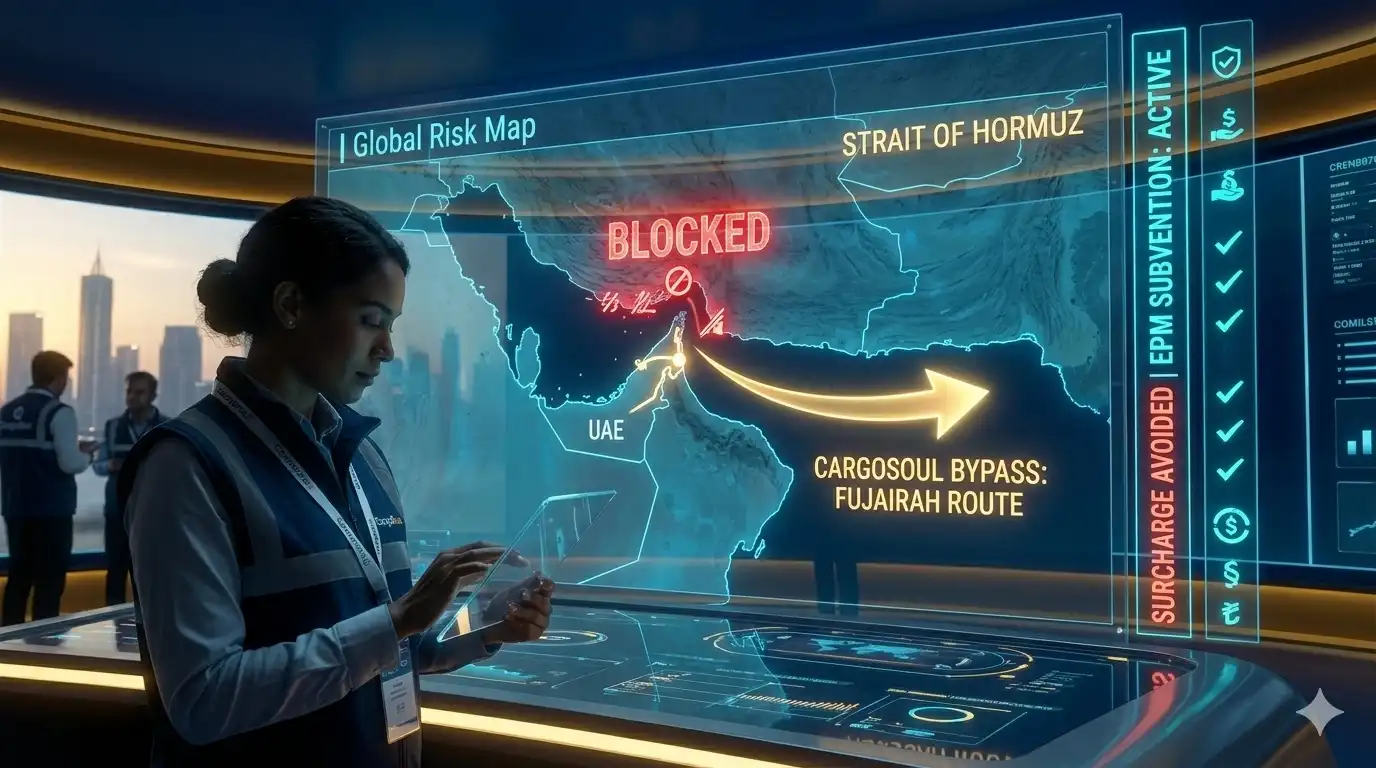
    The “Fujairah Pivot” Strategy At CargoSoul, we aren’t waiting for the congestion to clear. We are orchestrating a structural bypass.

    • The Route: We are rerouting mid-transit cargo to the Ports of Fujairah and Khorfakkan. By bypassing the Strait and utilizing land-bridge corridors, we avoid the “Contractual Deadlock” currently freezing Mumbai-to-West Asia routes.
    • The EPM Safety Net: We are helping clients leverage the Two Key Interventions Launched to Strengthen MSME Exports under Export Promotion Mission. Specifically, we are using the 2.75% interest subvention to offset the temporary spike in air-cargo rates, which have hit ₹425/kg.

    The US Finish Line Despite the maritime chaos, the long-term outlook remains bullish. Yesterday, at the Raisina Dialogue, the US Deputy Secretary of State confirmed that the India-US trade deal is close to the finish line.

  • Live from Mumbai: Orchestrating the Triple Trade Reset at Transport Logistic India 2026

    Live from Mumbai: Orchestrating the Triple Trade Reset at Transport Logistic India 2026

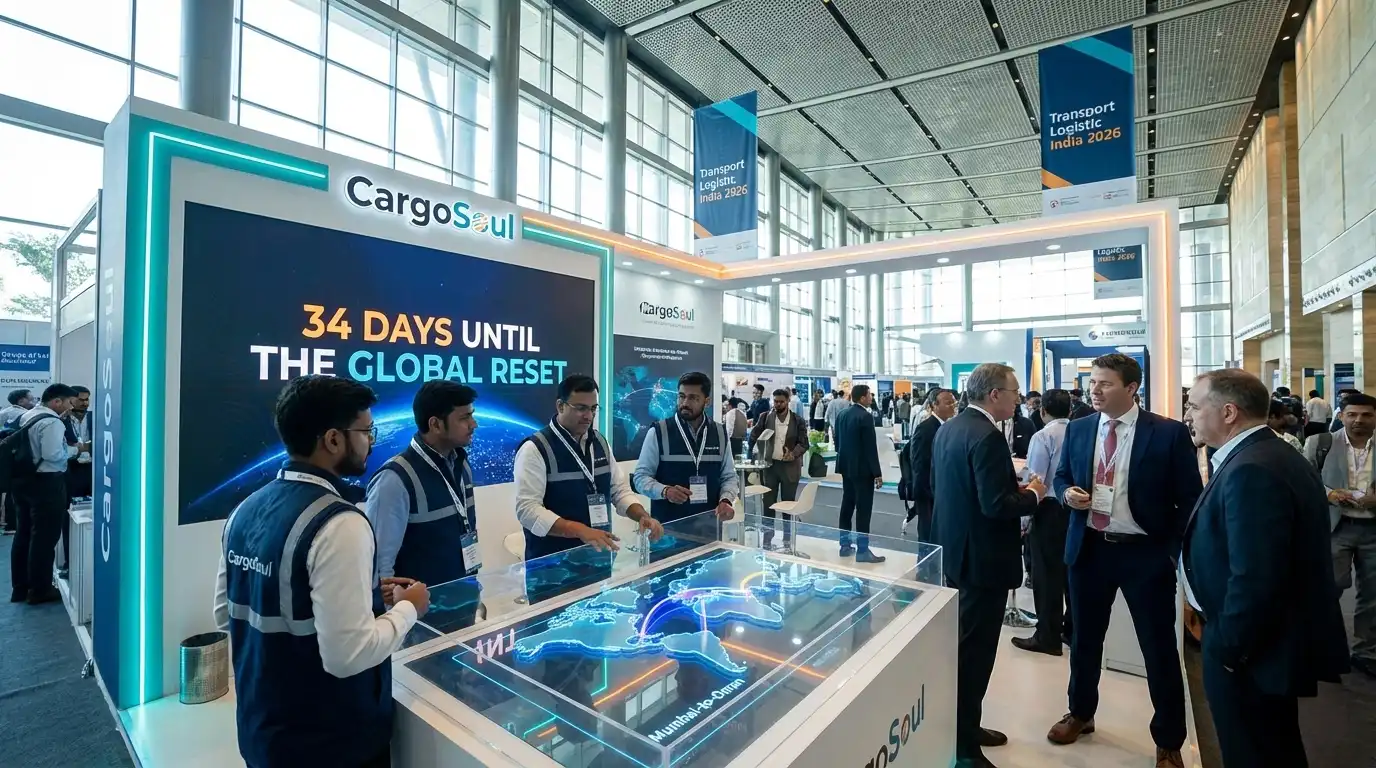
    Today, the inaugural edition of Transport Logistic India opened its doors at the Jio World Convention Centre in Mumbai. This isn’t just an exhibition; it is the “War Room” for the 34-day countdown to the April 1st Trade Reset.

    With the legal text being finalized as reported by Business Standard: India-US trade talks to finalize legal text from Feb 23, the conversation on the floor today has shifted from “what if” to “how now.”

    The MSME Advantage The most visited booth today? The Export Promotion Mission (EPM) pavilion. Yesterday’s PIB release on the Export Promotion Mission: Building an Integrated Pathway for MSMEs in Global Trade has changed the game. MSMEs are specifically looking at the new “Direct E-Commerce Credit” tools to fuel their April volume surge.

    Orchestrating the 7.97% Era As highlighted in the IBEF: Export Promotion Mission Overview, India’s goal is to maintain the 7.97% logistics cost benchmark. At CargoSoul, we aren’t just watching the trends; we are building the digital twins and multimodal links to ensure our clients hit this target. The timeline is tight, as confirmed by The Hindu: India-US Interim Pact likely in April.

  • The April 1st Trade Reset: 3 Critical Moves for Indian Exporters in the Next 40 Days

    The April 1st Trade Reset: 3 Critical Moves for Indian Exporters in the Next 40 Days

    The clock just started ticking for every exporter in India. This morning, Union Minister of Commerce and Industry Shri Piyush Goyal officially confirmed that the India-US Interim Trade Pact will be signed in March and operationalized in April 2026.

    According to The Hindu: India-US Interim Pact likely in April, this milestone will coincide with the implementation of the historic UK and Oman FTAs. This is a seismic shift in global trade corridors.

    Move 1: The “Tariff Locking” Strategy

    Starting April 1st, reciprocal tariffs with the US will be capped at 18%, down from 25%. In the UK, 99% of Indian exports will enter at zero duty.

    Move 2: Activating the ₹25,060 Crore EPM “Supercharge”

    Today’s launch of seven additional interventions under the Export Promotion Mission (EPM) provides the financial fuel for this expansion. For a deep dive into these tools, review the IBEF: Export Promotion Mission Overview.

    • The Opportunity: MSMEs can now access Export Factoring with a 2.75% interest subvention.
    • The CargoSoul Edge: We help you Optimize your MSME Export Strategy by integrating these trade finance tools directly into your logistics orchestration.

    Move 3: Defending the 7.97% Efficiency Standard

    India has hit a record low logistics cost of 7.97% of GDP. To win in 2026, your supply chain must be faster than the policy itself. Every hour of “dwell time” is a tax on your 18% tariff win.

  • The Navi Mumbai Pivot: Why the 300,000 sq. ft. FedEx-Adani Hub is a 2026 Time Machine

    The Navi Mumbai Pivot: Why the 300,000 sq. ft. FedEx-Adani Hub is a 2026 Time Machine

    This morning, in the presence of Maharashtra CM Devendra Fadnavis and FedEx CEO Raj Subramaniam, the first shovels hit the dirt at Navi Mumbai International Airport (NMIA). This isn’t just another warehouse; it is a 300,000 sq. ft. fully automated air cargo hub—a ₹2,500 crore investment that fundamentally changes how Western India trades with the world.

    Navi Mumbai: The “Time Machine” Effect

    In logistics, time is literally money. NMIA is designed to reduce cargo turnaround times by up to 40%.

    • The Automation: High-speed screening, dimensional scanning, and automated sorting systems mean your high-value electronics and life-saving pharmaceuticals move through the terminal at the speed of data.
    • The Multi-Modal Edge: Located just 14km from Jawaharlal Nehru Port (JNPT), this hub creates a “Sea-Air Bridge.” A container can arrive at the port, be de-stuffed, and its time-critical components can be on a FedEx flight to Europe or the US within hours.

    Hitting the 7.97% Gold Standard

    As we discussed earlier this week, India’s logistics cost has officially dropped to 7.97% of GDP. But that national average is only achievable if you utilize infrastructure like NMIA.

    • Manual vs. Machine: Old-school manual hubs suffer from “dwell time”—the hidden cost of cargo sitting idle. NMIA’s automated truck slot management eliminates this friction.
    • Predictability: With dedicated aircraft parking bays and simultaneous inbound/outbound processing, your supply chain moves from “estimation” to “execution.”

    CargoSoul: Your NMIA Gateway Partner

    At CargoSoul, we aren’t waiting for the hub to finish in 2028 to start planning. We are already integrating NMIA’s phase-one capacity (0.5 MMT) into our Western India Corridor strategy.

    • Specialized High-Value Lanes: We are setting up priority lanes for Semiconductor Equipment (ISM 2.0) and Biopharma, utilizing NMIA’s temperature-controlled “Pharma Excellence Centre.”
    • Global Redistribution: Use CargoSoul to leverage this hub as your regional consolidation point for Southeast Asia and West Asia.

    The Orchestrator’s View: “Infrastructure is the hardware, but orchestration is the software. You can have the world’s best automated hub, but without a partner like CargoSoul to navigate the customs, compliance, and multi-modal shifts, it’s just a very expensive building.”

  • Beyond the Dip: How India’s Textile Titans are Orchestrating the 2026 Rebound

    Beyond the Dip: How India’s Textile Titans are Orchestrating the 2026 Rebound

    If you were looking at the January export numbers, you might have felt a chill. Textile exports were down 3.75%. But at CargoSoul, we knew exactly what that was: the “Tariff Waiting Room.” Exporters were holding back shipments, waiting for the February 7th trigger of the India-US Interim Trade Agreement.

    Now, the floodgates have opened.

    The “18% Sweet Spot” vs. The Competition

    The strategic reset has placed Indian apparel in a “pole position.” For the first time, Indian exporters have a mathematical edge over their biggest rivals:

    • India: 18% (Reciprocal Tariff Cap)
    • Vietnam: 20%
    • Bangladesh: 20%
    • China: 30%+

    This 2%–12% advantage is already translating into a 20% surge in March order forecasts. The challenge for exporters is no longer “finding a buyer”—it’s “finding a container.”

    The New Gold Standard: 7.97% Logistics Cost

    In a separate but equally massive victory, the Economic Survey 2025-26 confirmed today that India’s logistics costs have officially dropped to 7.97% of GDP.

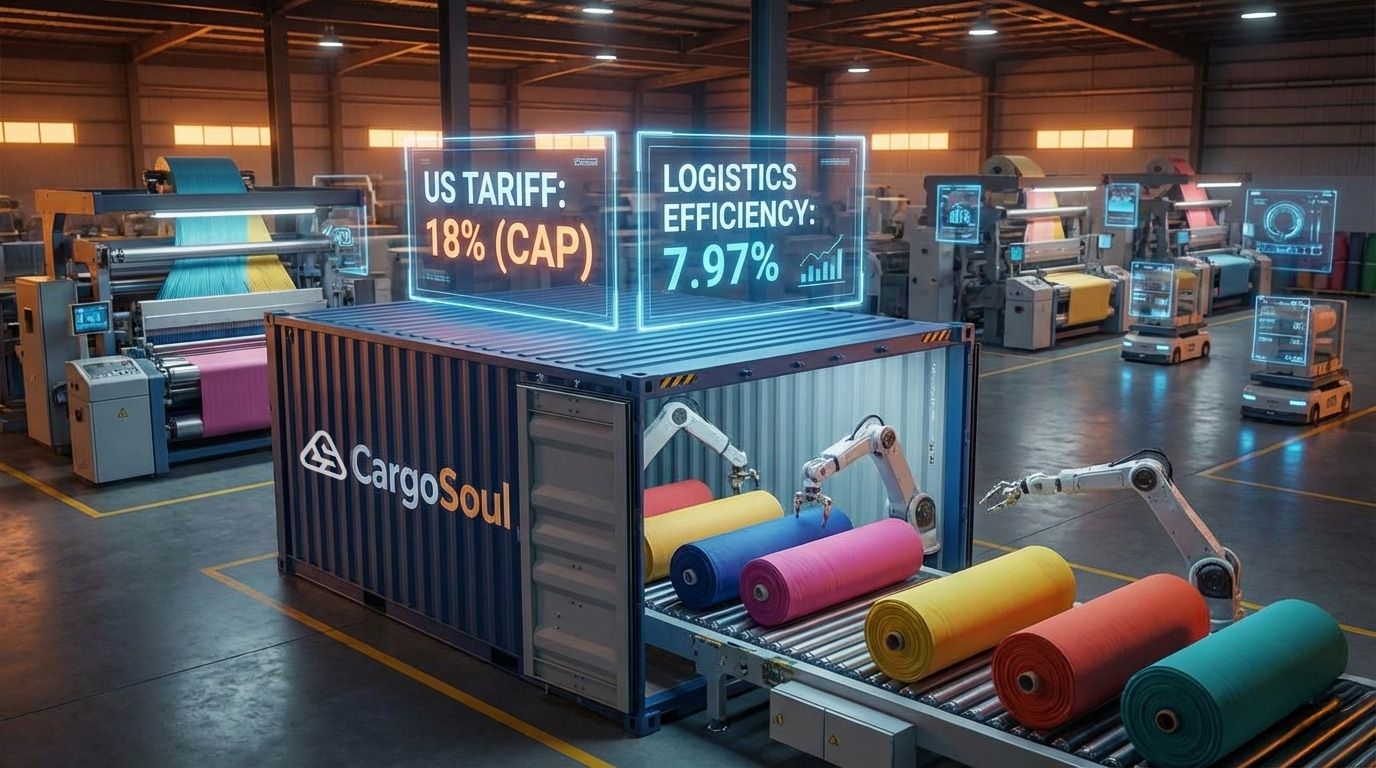
    This isn’t just a government stat; it’s your new benchmark. If your supply chain is still operating at the old 13%–14% cost structure, you are leaving your 18% tariff advantage on the table.

    How CargoSoul hits the 7.97% mark for you:

    • Multimodal Switching: We move long-haul textile volumes via Rail (₹1.96 PTPK) instead of traditional Road (₹3.78 PTPK) to slash line-haul costs.
    • Capacity Locking: With the March surge approaching, we are helping our partners lock in “Green Channel” space now to avoid the inevitable spot-rate spikes.
    • Precision Visibility: Every shipment is an asset. Our AI-driven Execution Intelligence eliminates the “hidden costs” of delays and port congestion.

    The Orchestrator’s View: From Fabric to Future-Tech

    The agility we are building for the textile rebound today is the foundation for tomorrow. As the India Semiconductor Mission 2.0 (ISM 2.0) gains momentum this month, the same precision we use for “Fibre-to-Fashion” will be deployed for the ultra-sensitive “Silicon-to-System” supply chains.

    Whether it’s a pallet of high-fashion silk or a crate of lithography sensors, the goal remains the same: Zero friction. Maximum margin.

    Is your supply chain operating below the 7.97% benchmark? Consult with CargoSoul to audit your 2026 export strategy today.

  • The Global Trade Super-Bridge 2026: Mastering the India-US Reset and the India-EU “Mother of All Deals

    The Global Trade Super-Bridge 2026: Mastering the India-US Reset and the India-EU “Mother of All Deals

    For the first time in history, the Indian export engine is firing on all cylinders toward both the Atlantic and the Pacific. February 2026 marks the moment India became the “Neutral Hub” for global trade, successfully navigating an Interim Agreement with the US and a Landmark FTA with the European Union.

    At CargoSoul, we’ve analyzed the “fine print” to help you move cargo through these new duty-free corridors.

    The Atlantic Bridge: India to the USA

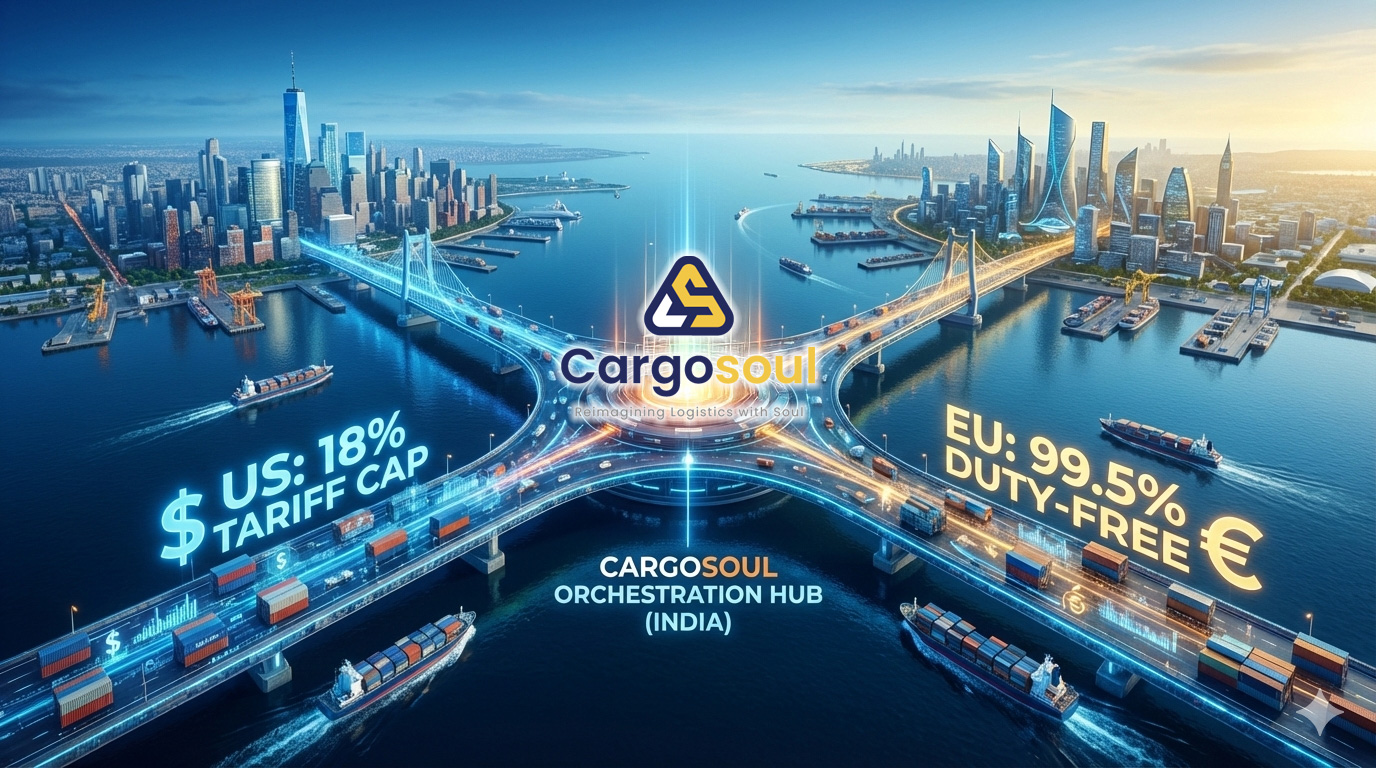
    The “tariff overhang” of 2025 has been replaced by a strategic partnership. The headline is the 18% Tariff Cap.

    • The Big Win: Effective immediately, the US has slashed duties on Indian goods from nearly 50% (inclusive of punitive layers) to a baseline 18%.
    • The Sourcing Shift: In exchange, India is pivoting its energy and tech sourcing to the US, pledging over $500 billion in purchases over five years.
    • Logistics Impact: This creates a massive surge in Bi-Directional Logistics. We aren’t just shipping “out”; we are managing the high-value “inbound” flow of US energy and tech components.

    The Continental Bridge: India to the European Union

    Dubbed the “Mother of All Deals,” the India-EU FTA has created the world’s largest free trade zone, covering 2 billion people.

    • The Big Win: The EU will eliminate or reduce tariffs on 99.5% of Indian goods over the next seven years.
    • Key Sectors: Textiles, leather, and agri-processed foods now have a clear, duty-free path into the heart of Europe.
    • The Green Barrier: However, the EU’s Carbon Border Adjustment Mechanism (CBAM) is now fully operational. Exporters must prove their “green credentials” to avoid carbon surcharges.
  • The 2026 Logistics Pivot: Navigating Delhi’s EV Mandate, the Cryo-Pharma Boom, and Zero-Tariff Export Gold Mines

    The 2026 Logistics Pivot: Navigating Delhi’s EV Mandate, the Cryo-Pharma Boom, and Zero-Tariff Export Gold Mines

    It is mid-February 2026, and the Indian logistics sector isn’t just evolving—it’s rewriting the rulebook. In a single week, we’ve seen a regulatory countdown in the North, a technical breakthrough in the South, and a massive commercial windfall in the West.

    For the modern enterprise, these aren’t just headlines; they are the pillars of a 2027-ready supply chain. At CargoSoul, we’re orchestrating the transition across all three.

    1. The Regulatory Countdown: Delhi’s EV Mandate

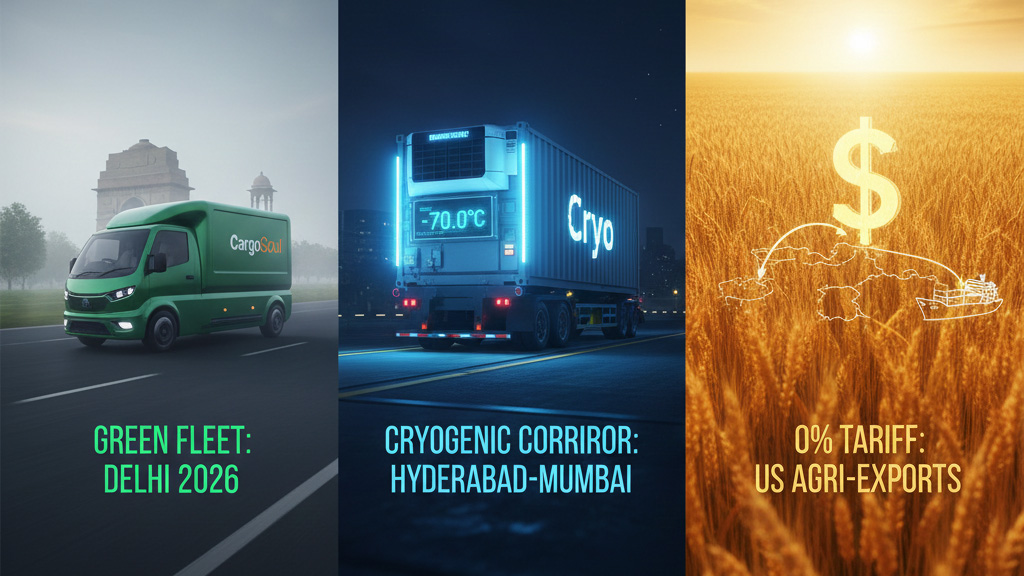
    The air in the National Capital Region is changing, and so is the way we move goods through it. The Commission for Air Quality Management (CAQM) has issued its final directive: all delivery fleets in Delhi must achieve 30% electric vehicle penetration by December 31, 2026.

    This isn’t just a sustainability goal; it’s a compliance necessity. Non-compliant 3PLs will face steep environmental surcharges starting next year. At CargoSoul, we’ve already integrated our proprietary Green Logistics Fleet Strategy into our NCR operations, ensuring our clients stay ahead of the “compliance curve” while benefiting from lower urban delivery costs.

    2. The Technical Breakthrough: The -70°C Cryo-Corridor

    Precision has a new benchmark. The formal inauguration of the Hyderabad-Mumbai Cryo-Corridor marks a massive leap for India’s biopharma exports. This “zero-stoppage” lane is designed specifically for high-value biologics and cell therapies that require deep cryogenic temperatures.

    Maintaining a steady -70°C across the Deccan Plateau isn’t easy—it requires more than just a refrigerated truck; it requires Precision Cold Chain Orchestration. By combining vacuum-insulated hardware with real-time thermal IoT, we ensure that life-saving cargo moves from the Genome Valley to global markets with zero thermal excursions.

    3. The Commercial Windfall: Zero-Tariff Agri Exports to the USA

    The latest SBI Economic Research Report (Feb 2026) confirmed a historic win for Indian trade: 75% of Indian agricultural exports to the U.S. now qualify for zero-tariff status. This landmark deal has opened a billion-dollar window for exporters of rice, spices, and organic produce.

    However, zero-tariff status is only profitable if your logistics can handle the surge. Exporters are now looking for Strategic Trade & Export Advisory to navigate the new digital “Rules of Origin” certificates and scale their volumes to meet American demand.


    Why “Orchestration” is the Only Way Forward

    Logistics in 2026 is no longer about moving boxes; it’s about moving data and compliance. Whether it’s meeting a “Green” mandate in Delhi, maintaining “Deep Cold” in Hyderabad, or chasing “Export Gold” in the U.S., you need a partner who sees the whole map.

    Is your supply chain pivoting fast enough? Consult the CargoSoul Strategic Team today for a 2026 Gap Analysis. Let’s build the “Soul” of your supply chain together.

  • NWQS 2026 Guide: How to Ensure Your Warehouse is Compliant (and Avoid Penalties)

    NWQS 2026 Guide: How to Ensure Your Warehouse is Compliant (and Avoid Penalties)

    MARCH 2026 UPDATE: IS YOUR FACILITY READY?

    The regulatory landscape for NWQS has shifted. We have released a new, actionable audit tool for operators.

    [Click here to view the 15-Point NWQS 2026 Compliance Checklist]

    The era of “storage as a shed” is officially over. Today, the Ministry of Commerce released the NWQS 2026 framework, a set of rigorous standards that will define the value of every square foot of industrial space in India.

    For the first time, a “Grade A” rating isn’t just about ceiling height or floor strength—it’s about Digital Intelligence.

    The “Grade A” AI Threshold

    Under the new mandate, to maintain or achieve a Grade A status, facilities must demonstrate:

    • AI-Driven Safety: Predictive hazard detection that uses computer vision to prevent forklift accidents and fire risks.
    • Energy Transparency: Real-time IoT monitoring of energy consumption, aligned with the 2026 ESG benchmarks.
    • Inventory Fluidity: An AI-integrated Warehouse Management System (WMS) that can interface directly with the national ULIP 2.0 grid.

    Quick Compliance Checklist: Is Your Warehouse NWQS Ready?

    • [   ] Infrastructure: Does the facility have Grade-A flooring and clear height specifications as per the 2026 guidelines?
    • [   ] Digitization: Is there a WMS (Warehouse Management System) capable of real-time inventory reporting for NWQS audits?
    • [   ] Safety: Are fire suppression systems and emergency exits certified within the last 12 months?
    • [   ] Sustainability: Does the warehouse have energy-efficient lighting or solar-readiness (a key NWQS quality marker)?
    • [   ] Documentation: Are all “Standard Operating Procedures” (SOPs) digitized and accessible to the floor staff via tablets/handhelds?

    Need an NWQS-Compliant Partner? CargoSoul’s managed warehouses are pre-vetted for 2026 quality standards. [Click here to request a facility audit.]

    The Risk: The “Downgrade Trap”

    Facilities that fail to integrate these technologies by December 31, 2026, risk being downgraded to Grade B or C. This isn’t just a label; it directly impacts your insurance premiums, your ability to serve high-value MNC clients, and your property valuation.

    How CargoSoul Bridges the Gap

    At CargoSoul, we don’t just rent space; we orchestrate intelligence. Our “Smart Upgrade Kit” is designed specifically to bring legacy warehouses into NWQS compliance without tearing down the walls.

    1. Overlay Intelligence: We deploy AI sensors and vision systems on top of your existing infrastructure.
    2. ULIP-Ready WMS: Our proprietary software ensures you are 100% compliant with the new digital reporting standards.
    3. Predictive Maintenance: We use digital twins to monitor your facility’s health, ensuring your “Grade A” audit is a breeze.

    Don’t Wait for the Audit

    The rush for NWQS certification has already begun. By the time the inspectors arrive, the best tech partners will be booked through 2027.

    Consult CargoSoul’s NWQS Taskforce today for a gap analysis and a roadmap to a smarter, compliant future.