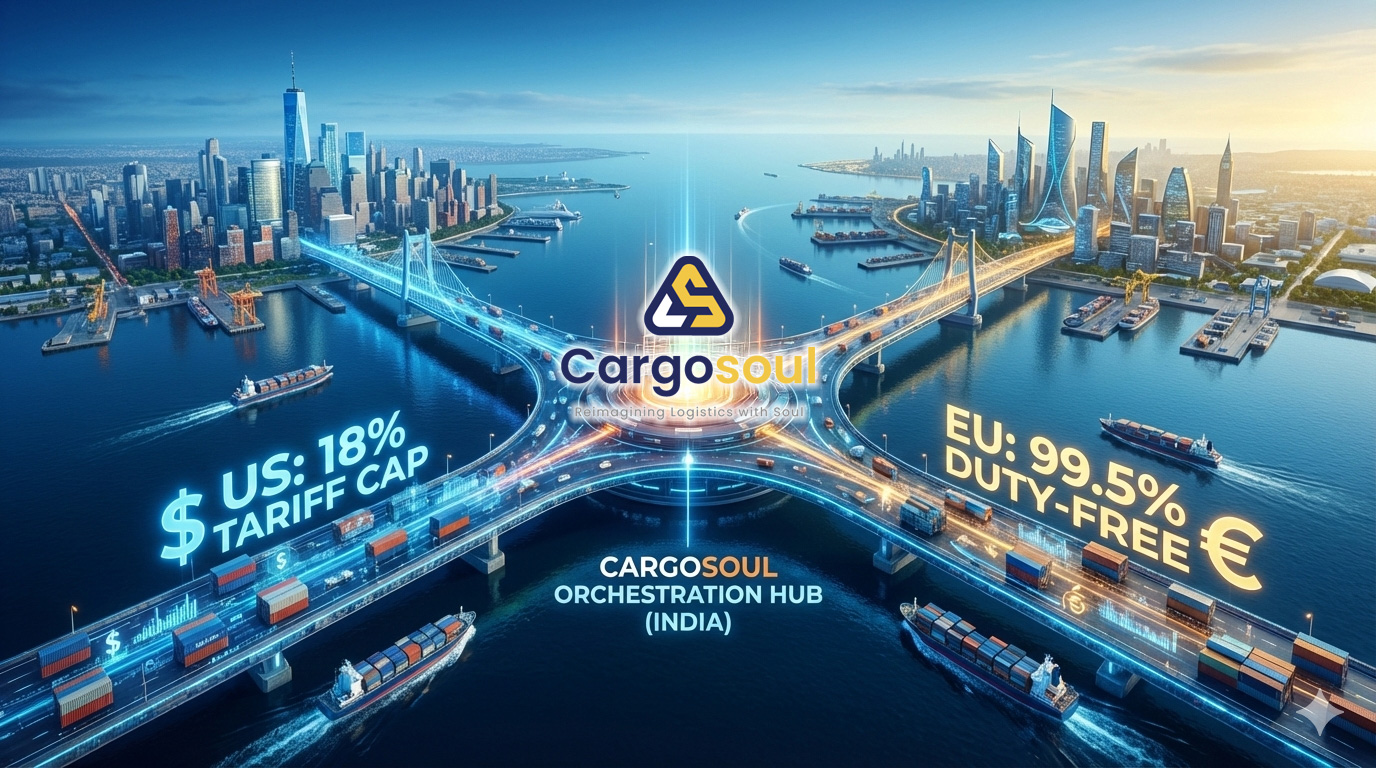
For the first time in history, the Indian export engine is firing on all cylinders toward both the Atlantic and the Pacific. February 2026 marks the moment India became the “Neutral Hub” for global trade, successfully navigating an Interim Agreement with the US and a Landmark FTA with the European Union.
At CargoSoul, we’ve analyzed the “fine print” to help you move cargo through these new duty-free corridors.
The Atlantic Bridge: India to the USA
The “tariff overhang” of 2025 has been replaced by a strategic partnership. The headline is the 18% Tariff Cap.
The Big Win: Effective immediately, the US has slashed duties on Indian goods from nearly 50% (inclusive of punitive layers) to a baseline 18%.
The Sourcing Shift: In exchange, India is pivoting its energy and tech sourcing to the US, pledging over $500 billion in purchases over five years.
Logistics Impact: This creates a massive surge in Bi-Directional Logistics. We aren’t just shipping “out”; we are managing the high-value “inbound” flow of US energy and tech components.
The Continental Bridge: India to the European Union
Dubbed the “Mother of All Deals,” the India-EU FTA has created the world’s largest free trade zone, covering 2 billion people.
The Big Win: The EU will eliminate or reduce tariffs on 99.5% of Indian goods over the next seven years.
Key Sectors: Textiles, leather, and agri-processed foods now have a clear, duty-free path into the heart of Europe.
The Green Barrier: However, the EU’s Carbon Border Adjustment Mechanism (CBAM) is now fully operational. Exporters must prove their “green credentials” to avoid carbon surcharges.
The world’s trade center of gravity is shifting. This week at the World Economic Forum in Davos, European Commission President Ursula von der Leyen officially confirmed what insiders have whispered for months: the European Union and India are on the cusp of the “Mother of all deals.”
This isn’t just another trade pact. We are looking at a unified economic corridor linking 2 billion people and accounting for nearly 25% of global GDP.
What This Means for Indian Industry
For Indian businesses, the timing couldn’t be more critical. With global trade tensions rising elsewhere, this FTA opens a direct, preferential gateway to the 27-nation EU bloc.
Textiles & Apparel: Currently, Indian textiles face 12-16% tariffs. This deal is expected to bring duties to zero, putting India on a level playing field with rivals like Bangladesh.
Pharmaceuticals: Expect faster regulatory alignment, making it easier for Indian generics to penetrate European healthcare systems.
Engineering & Manufacturing: Lower trade barriers will boost the export of auto components, machinery, and electronics.
IT & Professionals: Beyond goods, the deal focuses on “professional mobility,” making it easier for Indian tech talent to work across Europe.
The “GSP Gap”: Why You Need Smart Logistics Now
While the headlines are celebratory, there is a technical hurdle businesses must clear. As of January 1, 2026, the EU suspended “GSP benefits” for 87% of Indian exports. This means that until the FTA is fully implemented (which could take months), many exporters are temporarily paying higher “Most Favoured Nation” (MFN) tariffs.
Additionally, the Carbon Border Adjustment Mechanism (CBAM) has entered its definitive phase this month, adding new carbon-reporting layers to steel and aluminum exports.
How CargoSoul Navigates the New EU Reality
A trade deal of this magnitude creates massive opportunities—but only if your logistics can keep up. At CargoSoul, we are already helping our clients bridge the transition from GSP to FTA:
Strategic Freight Forwarding: We optimize your shipping routes to major EU hubs like Rotterdam, Antwerp, and Hamburg to ensure your cargo lands with maximum speed.
Customs & Compliance Mastery: From navigating the interim MFN tariffs to ensuring your documentation meets new CBAM carbon-reporting standards, our experts handle the red tape so you don’t have to.
End-to-End Visibility: In a high-stakes trade environment, knowing exactly where your shipment stands in the European customs queue is a competitive advantage.
The Bottom Line: The “Mother of All Deals” is about to unlock a new era of growth. Don’t let paperwork or port congestion hold you back.
How to Qualify for FTA Rates (February 2026 Update)
[ ] Certificates of Origin: Ensure your cargo has the newly digitized EU-India COO.
[ ] Value Addition Rules: Verify that 35-40% of your product value is created in India.
[ ] Direct Shipment: Goods must move directly between India and the EU to qualify.
[ ] Documentation Check: Does your HS Code match the new 2026 FTA annexure?