Blogs

  • Managing the 136 Million E-Way Bill Surge: How Containerization and AI Resolve India’s Supply Chain Strain

    Managing the 136 Million E-Way Bill Surge: How Containerization and AI Resolve India’s Supply Chain Strain

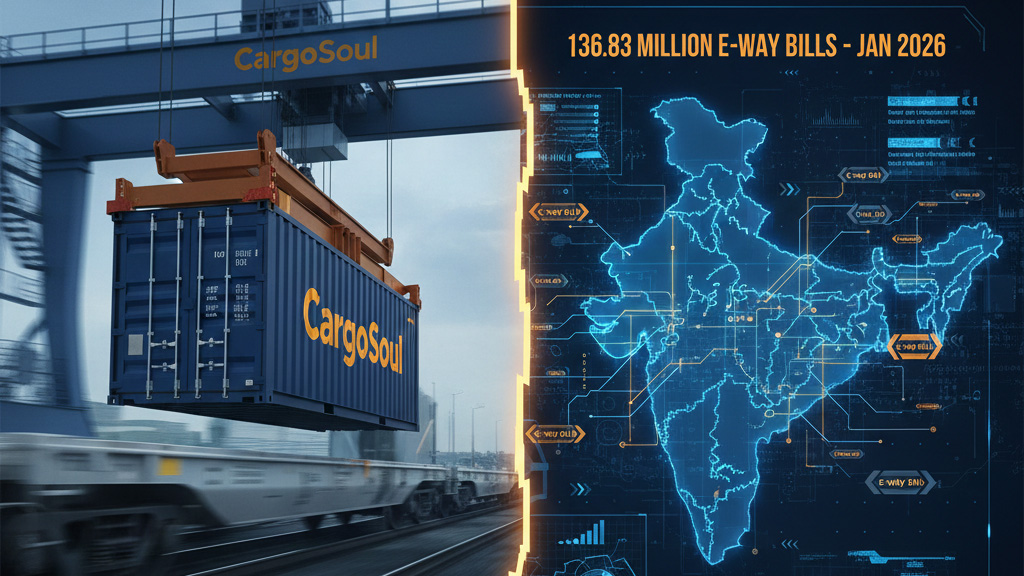
    India’s economy is moving at a blistering pace. According to the latest Business Standard report, e-way bill generation hit 136.83 million in January 2026—the second-highest level on record. While this 42.6% year-on-year growth is a sign of a robust market, it has triggered a “Supply Chain Strain” that traditional logistics models struggle to handle.

    The Pivot to Containerization: Lessons from the Agri-Sector

    As volumes spike, the risk of pilferage, damage, and transit delays increases. A major breakthrough in mitigating these risks came this week from the agri-logistics sector. As reported by India Shipping News, Adani Logistics successfully executed the first-ever containerized grain rake for the FCI, moving food grains from Ludhiana to Ahmedabad.

    By shifting from bulk to containers, the industry is seeing a significant reduction in transit losses. At CargoSoul, we are applying these same principles to our Train Freight Services. Containerization isn’t just for global trade anymore; it is the new standard for domestic rail-freight reliability in 2026.

    Solving “Volume Fatigue” with Execution Intelligence

    The sheer volume of 136 million bills means that manual tracking is no longer an option. The industry is currently facing what experts call “Volume Fatigue.” To counter this, CargoSoul has leaned into Execution Intelligence.

    Our Smart 3PL framework uses real-time data to predict bottlenecks before they happen. Whether it’s rerouting fleets around high-congestion corridors or optimizing Warehouse & Distribution workflows to match the E-way bill surge, we ensure that “growth” doesn’t lead to “gridlock.”

    Why Visibility is the New Currency

    With the government’s push for Trust-Based Customs Systems and digital trade facilitation, the margin for error is shrinking. Brands that can provide N-Tier Visibility are winning the trust of both the government and the end-consumer.

    We don’t just move boxes; we orchestrate data. By integrating our systems directly with the national logistics portals, we help our clients maintain 100% compliance while capitalizing on the record-high consumption levels of 2026. If you’re feeling the strain of this month’s surge, it’s time to Contact CargoSoul and upgrade to an intelligent supply chain.
  • The ₹2.3 Trillion Pivot: Why Urban Micro-Fulfillment is the Future of India’s Cold Chain

    The ₹2.3 Trillion Pivot: Why Urban Micro-Fulfillment is the Future of India’s Cold Chain

    India’s cold chain sector is no longer just about massive rural warehouses. Following the Union Budget 2026 focus on the “integrated development of fisheries and livestock,” as highlighted by FFOODS Spectrum, the industry is witnessing a structural transformation.

    From Rural Storage to Urban Micro-Fulfillment

    The real battle is now in the “last mile.” Industry giants like Snowman Logistics are rapidly expanding, with new facilities like their 5,900-pallet Pune hub set for 2026.

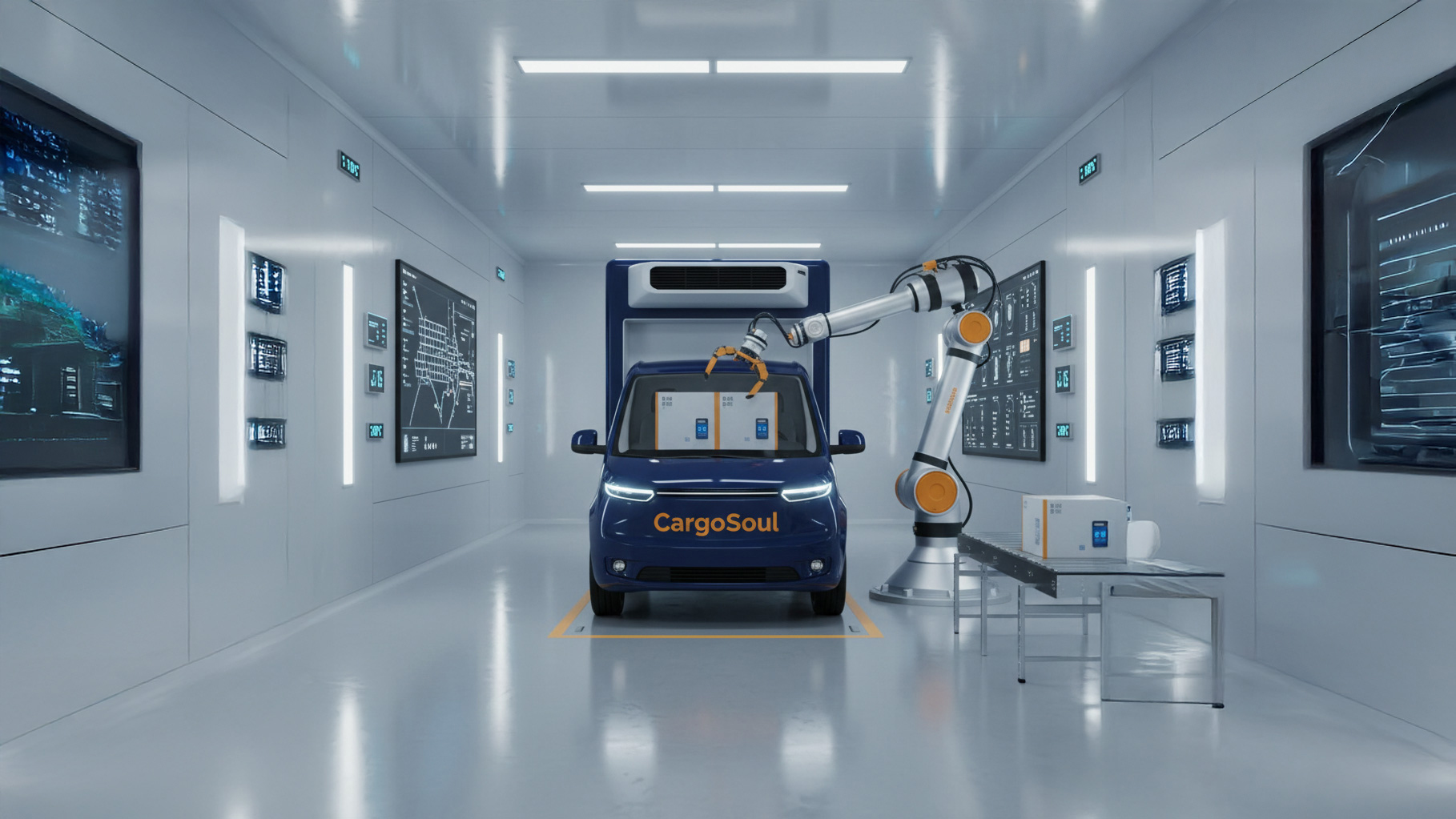
    At CargoSoul, we see the shift toward urban micro-fulfillment centers. These chilled “dark stores” are positioned within 3km of dense city clusters to meet the sub-15-minute delivery demands of modern quick-commerce.

    Solving the ₹92,000 Crore Waste Problem

    India currently loses roughly ₹92,000 crore annually due to gaps in the cold chain. According to Mordor Intelligence, the market is projected to reach $24.57 billion by the end of 2026.

    The solution? Execution Intelligence. By moving from manual logs to IoT-enabled sensors and LNG-fueled reefer trucking, we are cutting fuel costs by 20% while ensuring zero temperature excursions. This is the core of our CargoSoul Services—precision cooling that protects your bottom line.

    The “Compliance Cliff” of 2026

    It’s not just about profit; it’s about policy. New Bureau of Energy Efficiency (BEE) mandates and revised Schedule M guidelines for pharma mean that non-compliant facilities risk closure this year.

    CargoSoul is already ahead of the curve, integrating energy-efficient assets that align with the National Logistics Policy. Whether you are moving vaccines or artisanal gelato, the standard is now Precision Process Cooling.

  • India’s Logistics Revolution: Budget 2026 Unleashes High-Value Exports and Freight Corridors

    India’s Logistics Revolution: Budget 2026 Unleashes High-Value Exports and Freight Corridors

    The logistics landscape in India just underwent a seismic shift. The Union Budget 2026-27 isn’t just a financial statement; it’s a blueprint for a global supply chain superpower. At CargoSoul, we’re tracking two specific updates that will redefine how you move goods.

    The Death of the ₹10 Lakh Export Ceiling

    For years, high-value exporters—from luxury jewelry to precision electronics—were throttled by a ₹10 lakh value limit on courier exports. Businesses had to split shipments, doubling paperwork and delay risks.

    As reported by Upstox News, the government has officially scrapped this cap. This reform allows for seamless, high-value express exports, empowering Indian brands to compete globally without administrative friction. This is the “Smart 3PL” era where speed meets scale.

    The ₹12.2 Lakh Crore Infrastructure Engine

    Capital expenditure has hit a record high. According to the Shipway Budget Analysis, a massive focus has been placed on the East-West Dedicated Freight Corridor (DFC). This corridor, connecting Dankuni (West Bengal) to Surat (Gujarat), is set to slash transit times significantly.

    For our partners at CargoSoul Services, this means better N-Tier Visibility. We can now predict arrival times with higher precision as rail-freight reliability catches up to road transport. This transition is backed by a record ₹2.78 trillion railway allocation, as detailed by LiveMint.

    Economic Impact: What Budget 2026 Means for Margins

    The Rise of Multimodal Powerhouses

    The budget introduces the East-West Dedicated Freight Corridor, linking Dankuni in the east to Surat in the west. This isn’t just about more tracks; it’s about predictable delivery cycles. By operationalizing 20 new National Waterways, starting with NW-5 in Odisha, the government aims to double the share of coastal shipping to 12% by 2047.

    At CargoSoul, we see this as a game-changer for N-Tier Visibility. Shifting bulk cargo to water and rail reduces road congestion and slashes carbon footprints, allowing for smarter, more resilient supply chain designs.

    Green Freight & Sustainable “Smart 3PL”

    Sustainability is the recurring theme of 2026. The budget introduces Green Freight Zones and significant subsidies for electric trucks. With ESG Reporting (BRSR Core) becoming mandatory for more sectors by late 2026, adopting low-carbon logistics isn’t just “good for the planet”—it’s essential for compliance.

    Empowering the MSME Export Engine

    A landmark move for cross-border trade is the removal of the ₹10 lakh value cap on courier exports. This, combined with the new ₹10,000 crore SME Growth Fund, allows small-town enterprises to scale into global “champions.” Simplification of Rules of Origin (RoO) and a move toward a fully digital, trust-based customs framework will significantly reduce “dwell time” at ports.

    Why This Matters for Your Bottom Line

    With the government incentivizing “Made in India” container manufacturing, the perennial shortage of equipment is finally easing. Lower equipment costs plus faster transit via DFCs equals a leaner, meaner supply chain for your business.

    We are moving beyond simple transport. We are entering an era of Rules of Origin (RoO) compliance and ESG Reporting that the 2026 Budget heavily emphasizes. Feel free to Contact CargoSoul to see how we can align your 2026 strategy with these new regulations.

  • From 50% to 18%: The US-India “Father of All Deals” and Your Export Roadmap

    From 50% to 18%: The US-India “Father of All Deals” and Your Export Roadmap

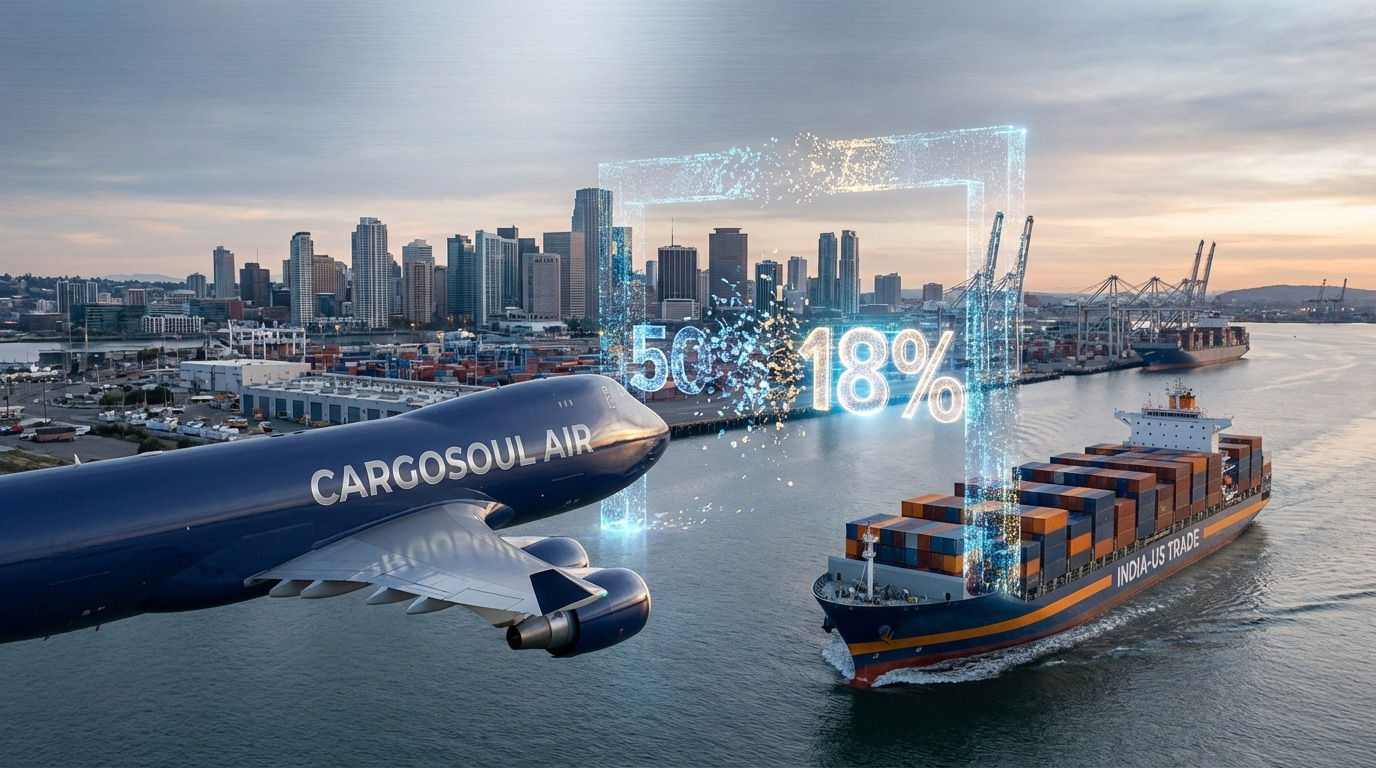
    The logistics world just woke up to a new reality. On February 2, 2026, President Trump and PM Modi finalized what is being called the “Father of All Deals,” effectively ending the trade friction that defined late 2025. According to reports from The Economic Times, effective tariffs on US-bound goods have plummeted from a staggering 50% to a flat 18%.

    This isn’t just a minor adjustment; it’s a total recalibration of the global supply chain. If you’ve been holding back on US shipments due to “punitive” costs, the green light is officially on. We are already seeing The Hindu report a surge in inquiries as the industry digests this massive shift.

    The Math Behind the 18%

    To understand the win, look at what was scrapped. The previous 50% wall was built on two pillars: a 25% reciprocal tariff and a 25% punitive tariff linked to India’s Russian oil strategy. By agreeing to pivot energy procurement toward the US and Venezuela, India secured the removal of the punitive layer.

    The result? A single 18% effective duty. In the cutthroat world of international trade, this 32% “discount” is the difference between a warehouse full of dead stock and a record-breaking fiscal year. Analysts at Drishti IAS highlight that this strategic pivot secures long-term stability for Indian manufacturers.

    The US Importer’s Checklist: Moving Cargo from India in 2026

    For US-based procurement officers and supply chain managers, 2026 is the year of the ‘Resilient Pivot.’ As you diversify away from China-centric sourcing, the India-US corridor offers massive duty savings, but only if your logistics partner handles the ‘Last Mile’ of compliance. Here is your 3-point checklist for 2026:

    [ ] DDP (Delivered Duty Paid) Specialist: Don’t get stuck with surprise port fees. CargoSoul provides end-to-end DDP services, moving your goods from Indian factories directly to your US warehouse with all duties pre-cleared.

    [ ] Real-Time Visibility & Agentic AI: US importers can no longer afford ‘tracking black holes.’ We utilize Agentic AI to monitor your cargo 24/7, predicting delays before they happen and rerouting as needed.

    [. ] China+1 Readiness: We specialize in ‘Sourcing Shift’ logistics. If you are moving production from SE Asia to India, our local expertise ensures your HS codes are optimized for the 2026 US-India trade protocols.

    India’s “Unfair” Advantage

    For the first time in years, India holds a clear tariff lead over its fiercest regional rivals. While India sits at 18%, Vietnam and Bangladesh are currently hovering at 20%, and China remains sidelined with tariffs north of 30%.

    For sectors like textiles, gems and jewelry, and auto components, this is a golden window. US buyers are already looking to shift contracts away from higher-tariff zones. Learn how our service offerings can help you capitalize on this shift before the competition catches up.

    The CargoSoul Perspective: Speed & Compliance

    This deal isn’t just about lower duties; it’s about Strategic Reliability. The commitment to a $500 billion “Buy American” energy and tech spend by India ensures this partnership is built to last. You can read more about our commitment to navigating these global shifts on our about page.

    At CargoSoul, we’re moving fast to update our customs documentation frameworks. Lower tariffs mean higher volumes, which can lead to port congestion. We are helping our clients leverage N-Tier Visibility to ensure that while the tariffs are lower, the speed to market remains higher than ever. Contact our trade desk today to start your US-bound expansion.

  • India Budget 2026: 5 Critical Logistics & Export Changes for Shippers

    India Budget 2026: 5 Critical Logistics & Export Changes for Shippers

    The Union Budget 2026 has officially pivoted logistics from a backend support function to the “National Growth Engine.” Finance Minister Nirmala Sitharaman’s announcement of a record ₹12.2 lakh crore capital expenditure signals a massive shift toward infrastructure-led competitiveness. For businesses moving goods across India, the message is clear: efficiency is no longer optional; it is the new mandate.

    The Rise of Multimodal Powerhouses

    The budget introduces the East-West Dedicated Freight Corridor, linking Dankuni in the east to Surat in the west. This isn’t just about more tracks; it’s about predictable delivery cycles. By operationalizing 20 new National Waterways, starting with NW-5 in Odisha, the government aims to double the share of coastal shipping to 12% by 2047.

    At CargoSoul, we see this as a game-changer for N-Tier Visibility. Shifting bulk cargo to water and rail reduces road congestion and slashes carbon footprints, allowing for smarter, more resilient supply chain designs.

    Green Freight & Sustainable “Smart 3PL”

    Sustainability is the recurring theme of 2026. The budget introduces Green Freight Zones and significant subsidies for electric trucks. With ESG Reporting (BRSR Core) becoming mandatory for more sectors by late 2026, adopting low-carbon logistics isn’t just “good for the planet”—it’s essential for compliance.

    Empowering the MSME Export Engine

    A landmark move for cross-border trade is the removal of the ₹10 lakh value cap on courier exports. This, combined with the new ₹10,000 crore SME Growth Fund, allows small-town enterprises to scale into global “champions.” Simplification of Rules of Origin (RoO) and a move toward a fully digital, trust-based customs framework will significantly reduce “dwell time” at ports.


    Backlinks

  • The $10 Billion Pivot: Why Walmart and IKEA are Betting Big on Indian Logistics

    The $10 Billion Pivot: Why Walmart and IKEA are Betting Big on Indian Logistics

    The “Business of Brands” is undergoing a historic transformation. As recently reported by ET Brand Equity, retail giant Walmart has committed to exporting $10 billion worth of goods from India annually by 2027. Hot on their heels, IKEA is rapidly expanding its “Made in India” toy and home furnishing portfolio for global markets.

    This isn’t just a win for manufacturing; it is a massive challenge—and opportunity—for Logistics Orchestration.

    1. The “Walmart Effect”: Beyond Capacity to Quality

    Walmart’s focus on toys and electronics as key export pillars means Indian MSMEs must now meet global “Shelf-Ready” standards. As the Budget 2026 introduces the “Make in India 2.0” framework, the focus has shifted from high-volume shipping to high-precision supply chains. To compete with China and Vietnam, Indian brands need more than just a warehouse; they need a Smart 3PL Partner.

    2. The India-EU FTA Catalyst

    While Walmart eyes the US, the recently finalized India-EU FTA (the “Mother of All Deals”) has opened a zero-duty corridor to Europe. For brands like IKEA, this means India is now the most cost-effective hub for supplying the 450 million consumers in the EU.

    3. The Compliance Frontier: CBAM & ESG

    Sourcing in 2026 comes with a “Green Mandate.” European and US retailers now require verified carbon footprints. Every container moving from an Indian port must be backed by transparent, AI-driven data. This is where the transition from “Moving Boxes” to “Orchestrating Growth” truly happens.

    How CargoSoul Powers Global Retail Ambitions

    At CargoSoul, we are the bridge between Indian quality and global retail shelves. We support the Walmart/IKEA sourcing shift through:

    • Export-Ready 3PL: Seamlessly managing the transition from local manufacturing to international fulfillment.
    • Smart Warehousing: Our AI-powered hubs ensure that goods are audit-ready and compliant with EU/US safety standards.
    • Digital Transparency: Providing the real-time visibility required by global giants to manage their “Just-in-Time” inventories.

    The Bottom Line: The world’s biggest brands have placed their $10 billion bet on India. Is your logistics backbone strong enough to carry it?

    Consult with our Global Sourcing Specialists today for an FTA-Ready Audit.

  • The Great Sourcing Shift: Why the “Mother of All Deals” Changes Everything for Brands

    The Great Sourcing Shift: Why the “Mother of All Deals” Changes Everything for Brands

    The landscape of global trade has officially shifted. As of late January 2026, the finalized India-EU Free Trade Agreement (FTA) has moved beyond policy and into the “Business of Brands.”

    According to reports from ET Brand Equity, European retail icons—including Zara and Ikea—are aggressively recalibrating their supply chains. The goal? To leverage the 0% duty access on 99.5% of Indian exports.

    At CargoSoul, we believe this isn’t just a trade win; it is a complete logistics reset.

    From “Moving Freight” to “Orchestrating Growth”

    The removal of tariff barriers is only half the battle. As Indian manufacturers scale to meet this European demand, the real challenge lies in the technicalities:

    • Rules of Origin (RoO) Compliance: Proving the “Indian-ness” of products to claim 0% duty.
    • ESG & CBAM Reporting: Navigating the EU’s new carbon taxes and sustainability audits.
    • Supply Chain Visibility: Moving from simple shipping to AI-driven 3PL orchestration.

    The 2026 EU Export Readiness Checklist

    Before shipping your first FTA-compliant container, ensure your brand clears these five hurdles:

    1. HS Code Re-Verification: Ensure your products are categorized under the new 0% duty brackets.
    2. Audit-Proof Documentation: The EU is strict on “Value-Add” thresholds. Your RoO paperwork must be flawless.
    3. CBAM Carbon Tracking: From 2026, exporters in metals and chemicals must provide verified emissions data.
    4. Shelf-Ready Warehousing: Use smart warehousing to ensure goods are packaged and ready for European retail standards before they even leave India.
    5. Multimodal Agility: In a high-demand era, having the ability to switch between Ocean Freight and Air Cargo is vital for brand reputation.

    The CargoSoul Advantage

    Combining 20 years of logistics grit with the precision of 2026’s smartest technology, we help you navigate this $2.5 trillion transition. We don’t just move boxes; we ensure your brand thrives in the world’s most demanding market.

    Ready to scale your exports to Europe? Contact our FTA Specialists today for a Free Quote.

  • Beyond Borders: How the India-EU “Mother of All Deals” is Globalizing Indian Brands

    Beyond Borders: How the India-EU “Mother of All Deals” is Globalizing Indian Brands

    Today, January 27, 2026, marks a tectonic shift in the “Business of Brands.” As Prime Minister Narendra Modi meets with EU leaders Ursula von der Leyen and Antonio Costa, the world is watching the finalization of the India-EU Free Trade Agreement (FTA)—widely hailed as the “Mother of All Deals.”

    For years, Indian brands in apparel, electronics, and lifestyle have been “Domestic Giants.” Today, they become “Global Contenders.”

    1. From ‘Made in India’ to ‘Sold in Paris’

    The deal is expected to slash tariffs across critical sectors. For the Apparel and Textile industry—a staple of Indian brand equity—the shift from a 12% duty to zero-duty access means Indian labels can finally compete head-to-head with global fast-fashion rivals. As reported by ET Brand Equity, brands like Godrej are already eyeing acquisitions and global expansions; this FTA provides the highway to do so.

    2. Navigating the “GSP Gap”

    However, the road to Europe isn’t without its speed bumps. Since January 1, 2026, the EU has suspended GSP benefits for 87% of Indian exports. This “interim period” before the FTA fully kicks in is where brands win or lose.

    To maintain brand value, companies cannot afford price hikes or supply chain delays. This is where Logistics Orchestration becomes the secret sauce of brand equity.

    3. The Green Tax: CBAM & Brand Responsibility

    Modern European consumers value sustainability. The new Carbon Border Adjustment Mechanism (CBAM), which entered its tax phase this month, requires brands to report verified carbon emissions. A brand’s “Green Equity” is now literally a line item on their customs invoice.

    How CargoSoul Orchestrates Your Global Leap

    At CargoSoul, we believe that a trade deal is only a piece of paper without the logistics to back it up. We are helping Indian brands transition into the EU market through:

    • Smart 3PL Fulfillment: Managing the “GSP to FTA” transition with optimized duty strategies.
    • CBAM-Ready Shipping: Providing the data-driven reporting required for EU carbon compliance.
    • End-to-End Visibility: Ensuring that your brand’s promise of “Quality on Time” is kept, from a warehouse in Pune to a storefront in Berlin.

    The Bottom Line: The “Mother of All Deals” has opened the door. Is your supply chain ready to walk through it?

  • India-EU FTA 2026: The Shipper’s Guide to Zero-Duty Exports & New Tariff Schedules

    India-EU FTA 2026: The Shipper’s Guide to Zero-Duty Exports & New Tariff Schedules

    The deal is signed. As of February 2026, here is the sector-by-sector breakdown of duty eliminations and how to claim your ‘Rules of Origin’ benefits.

    Immediate Duty Eliminations: February 2026

    IndustryPre-FTA DutyNew 2026 DutyImmediate Impact
    Textiles & Apparel12%0%High (Direct Savings)
    Leather Goods9-11%0%High (Sourcing Shift)
    Gems & Jewelry5%0%Moderate (Margin Boost)
    Machinery/Parts4-6%0%Supply Chain Efficiency

    Confused about your HS Code? [Get a Free FTA Compliance Audit for your Cargo]

    The world’s trade center of gravity is shifting. This week at the World Economic Forum in Davos, European Commission President Ursula von der Leyen officially confirmed what insiders have whispered for months: the European Union and India are on the cusp of the “Mother of all deals.”

    This isn’t just another trade pact. We are looking at a unified economic corridor linking 2 billion people and accounting for nearly 25% of global GDP.

    What This Means for Indian Industry

    For Indian businesses, the timing couldn’t be more critical. With global trade tensions rising elsewhere, this FTA opens a direct, preferential gateway to the 27-nation EU bloc.

    • Textiles & Apparel: Currently, Indian textiles face 12-16% tariffs. This deal is expected to bring duties to zero, putting India on a level playing field with rivals like Bangladesh.
    • Pharmaceuticals: Expect faster regulatory alignment, making it easier for Indian generics to penetrate European healthcare systems.
    • Engineering & Manufacturing: Lower trade barriers will boost the export of auto components, machinery, and electronics.
    • IT & Professionals: Beyond goods, the deal focuses on “professional mobility,” making it easier for Indian tech talent to work across Europe.

    The “GSP Gap”: Why You Need Smart Logistics Now

    While the headlines are celebratory, there is a technical hurdle businesses must clear. As of January 1, 2026, the EU suspended “GSP benefits” for 87% of Indian exports. This means that until the FTA is fully implemented (which could take months), many exporters are temporarily paying higher “Most Favoured Nation” (MFN) tariffs.

    Additionally, the Carbon Border Adjustment Mechanism (CBAM) has entered its definitive phase this month, adding new carbon-reporting layers to steel and aluminum exports.

    How CargoSoul Navigates the New EU Reality

    A trade deal of this magnitude creates massive opportunities—but only if your logistics can keep up. At CargoSoul, we are already helping our clients bridge the transition from GSP to FTA:

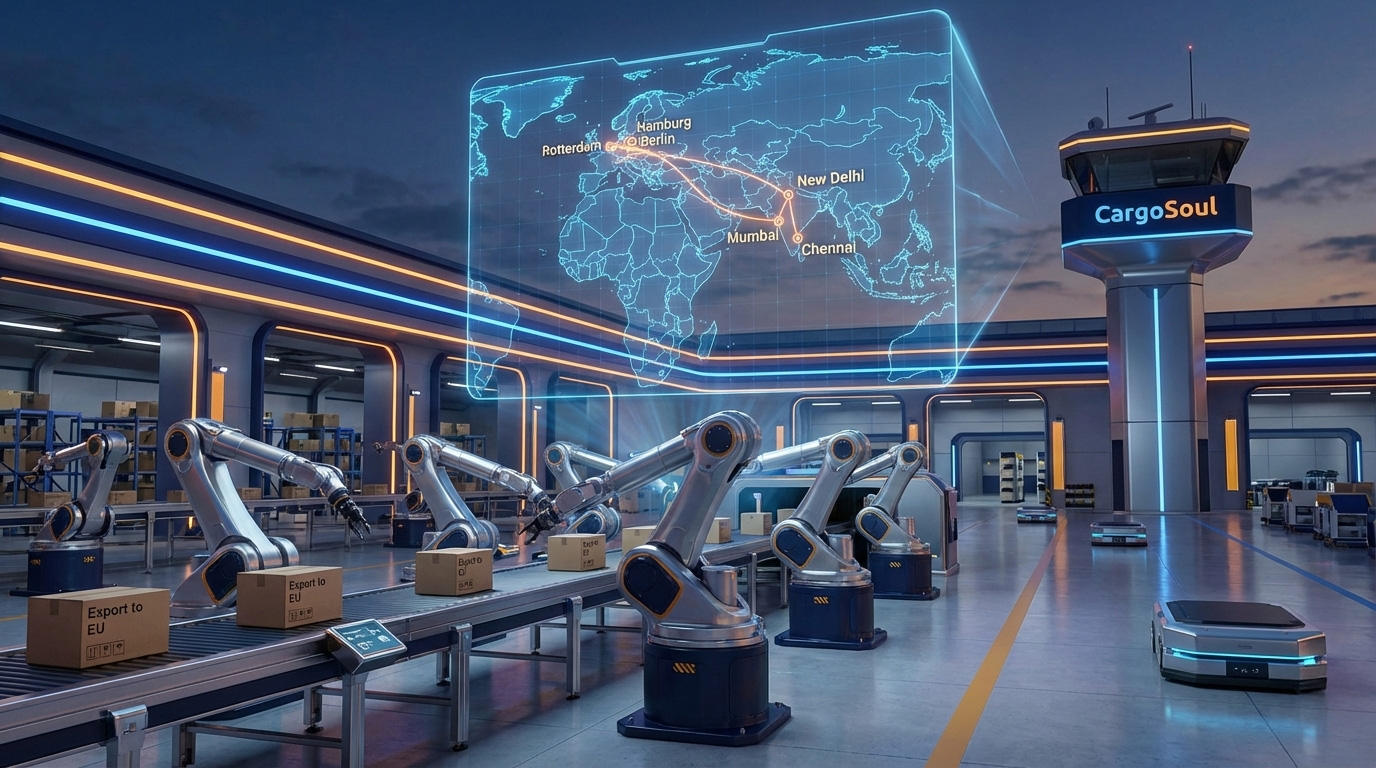
    1. Strategic Freight Forwarding: We optimize your shipping routes to major EU hubs like Rotterdam, Antwerp, and Hamburg to ensure your cargo lands with maximum speed.
    2. Customs & Compliance Mastery: From navigating the interim MFN tariffs to ensuring your documentation meets new CBAM carbon-reporting standards, our experts handle the red tape so you don’t have to.
    3. End-to-End Visibility: In a high-stakes trade environment, knowing exactly where your shipment stands in the European customs queue is a competitive advantage.

    The Bottom Line: The “Mother of All Deals” is about to unlock a new era of growth. Don’t let paperwork or port congestion hold you back.

    How to Qualify for FTA Rates (February 2026 Update)

    • [ ] Certificates of Origin: Ensure your cargo has the newly digitized EU-India COO.
    • [ ] Value Addition Rules: Verify that 35-40% of your product value is created in India.
    • [ ] Direct Shipment: Goods must move directly between India and the EU to qualify.
    • [ ] Documentation Check: Does your HS Code match the new 2026 FTA annexure?

    Ready to export to the new EU market? Contact CargoSoul’s EU-Trade Experts today for a seamless transition.

  • Navigating the 2026 Trade Fog: Why Resilience is Your Brand’s New Best Friend

    Navigating the 2026 Trade Fog: Why Resilience is Your Brand’s New Best Friend

    The dust has not yet settled on 2026. According to the latest DP World survey released this week at Davos, over 53% of supply chain executives anticipate “high or very high” policy uncertainty this year. With new trade barriers rising and the “tit-for-tat” tariff environment persisting, the “Just-in-Time” model of the past is being officially retired.

    In its place? The Era of Strategic Resilience.

    The “Red Sea Return” and the Capacity Crunch

    We are seeing the first signs of a potential return to the Suez Canal as ceasefires stabilize, but the transition is anything but smooth. While some carriers are testing the waters, others remain routed around the Cape of Good Hope. This “dual-route” reality is creating a temporary overcapacity crisis, leading to volatile freight rates that can shift by the week.

    For businesses shipping between Asia and Europe, this means your logistics strategy must be “elastic.” You cannot rely on a single route or a single carrier.

    India: The 2026 Growth Engine

    While global trade growth is expected to slow slightly, India and the US are the outliers. India, in particular, has recorded the highest share of respondents (79%) anticipating faster trade growth in 2026 compared to last year.

    At CargoSoul, we are seeing this firsthand. Our clients are no longer just asking “how much?”—they are asking “how resilient?” They are diversifying their supplier bases through “friend-shoring” and building higher inventory buffers to protect against sudden tariff hikes.

    Turning Volatility into Advantage

    Resilience isn’t just about surviving a crisis; it’s about having the infrastructure to pivot when your competitors are stuck. To win in 2026, your brand needs:

    • Diversified Routing: Having pre-vetted alternatives for every major trade lane.
    • Tariff-Ready Pricing: Factoring potential customs shifts into your landing costs before they happen.
    • Digital Governance: Using real-time data to prove your ESG Compliance as regulations tighten.

    The Bottom Line: The “Trade Fog” of 2026 is thick, but it isn’t impassable. With CargoSoul as your navigator, we turn these global hurdles into your strategic edge.

    Don’t get caught in the fog. Consult with a CargoSoul Resilience Expert today.